Beyond Entertainment: What Video Games Teach Us.
Video games have long been dismissed as being a guilty pleasure. Since their early days in arcades and home consoles, they have primarily been framed as simply a tool for entertainment - addictive and hypnotic - and in the eyes of many, potentially harmful. But today, video games are one of the most popular and dominant ingredients of twenty-first century culture. They are no longer niche distractions, but complex, narrative-driven worlds built by armies of writers, designers, and programmers who spend years crafting systems meant to be lived inside. And increasingly, these worlds ask players to do more than just simply win.
What if we could use these to our advantage? What if the very medium which has long been criticized for its supposed brain numbing effects, could actually be teaching players something valuable? What if games are quietly doing what traditional classrooms often struggle to, engaging students through experience instead of instruction?
A few months ago I did an interview with Robert Ghrist, a professor of mathematics and electrical and systems engineering at the University of Pennsylvania. This is where he enthusiastically revealed to me that he too is a gamer, “Yes I love video games. Video games are an unappreciated art-from. I love really rich story-based video games”. He explained that he has a love for making digital art work and got into it as a byproduct of trying to teach better, “Anything dynamic needs to be in motion, it needs to be animated”.
His taste in games, he admits, leans towards what he described as “Japanese existential angst depressing games”. He mentioned NieR Automata and Death Stranding."I get the same feelings playing depressing existential Japanese video games as I get reading Dostoevsky”, emphasizing their emotional and philosophical depth.
What struck me most though, was Ghrist’s comparison between gaming and education, “A video game you might put forty hours into it, that's about the same length of commitment as a course. In the sense that a typical course would be about 40 hours of lecturing”. He continued imagining what teaching may look like if courses were designed with the same sense of narrative, pacing, challenge, and immersion that video games give their players.
This comparison got me thinking about whether the lines between school and gaming should cross more. Not in the sense that I’m suggesting turning classrooms into gaming platforms, but vice versa. If games already require the same level of attention, time and emotional investment as formal education, then what have they been teaching players along the way? Can narrative video games function as tools for learning in a way that current school curriculum can't?
Moral Choice in Detroit: Become Human:
One of the clearest ways in which video games can function as teaching tools is through moral decision-making. Unlike books or films, games often place players directly inside the ethical dilemmas, acting as a simulation which forces us to choose a course of action without knowing whether it is the correct one. In a traditional classroom, ethical dilemmas are normally discussed at a safe distance, but in games, players must decide within the heat of the moment, with no certainty. The decisions made in games are often not in isolation, but ripple out into the rest of the world of the game, shaping relationships, altering narrative paths and in some cases, determining the ending of the game. A prominent example of this is seen with Detroit: Become Human, a narrative-driven game set in a dystopian, technologically advanced version of Earth in 2038 where advanced humanoid robots exist amongst humans. These androids function as domestic helpers, labourers and caregivers to humanity, taking over the majority of menial tasks. The manufacturing company of these androids, CyberLifer, say the machines are perfectly safe and under control, however, when a few begin to show human-like qualities and awareness, fear begins to grow.
You begin the game by playing as ‘Connor, an android built specifically to hunt down ‘deviants’ (other androids who have gone rogue by deviating from their original programming by gaining true sentience, free will, and emotions, allowing them to defy orders and develop unique personalities, just as humans would). Connor is sent to negotiate with a deviant android who has murdered his owner and taken the owner’s child hostage. Connor’s mission is to pacify him and the player can approach the situation coldly, treating the deviant as just a malfunction to be contained, or with empathy, acknowledging his fear and confusion, even though it may look bad to the humans who control him. The outcome, whether the child lives or dies with the deviant, depends entirely upon the player’s choices. From the opening, the game establishes its core lesson: how you act matters.
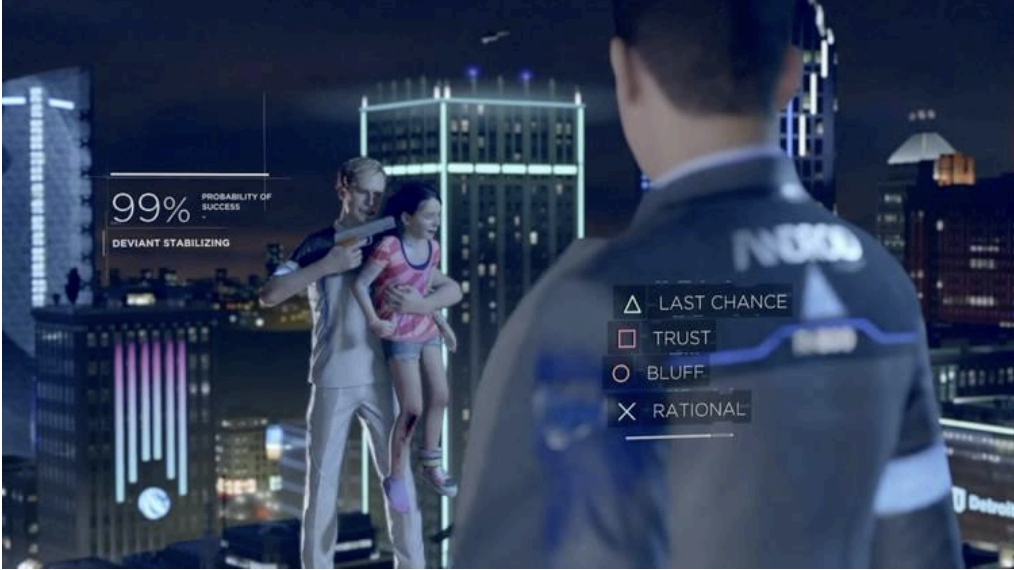
An image of the game which gives players the choice to shoot the deviant android or convince it through words to let the girl go.
As the story progresses, Connor is partnered with ‘Hank’, a human detective deeply distrustful of androids. Despite this hostile beginning, the two gradually develop a close and emotionally complex relationship. In one pivotal moment later in the game, the pair chase a deviant across a rooftop, and during this pursuit, Hank slips and hangs from the edge of a building. The player is then forced to make a quick decision: to help Hank, or continue in pursuit of the deviant as the mission ordered.
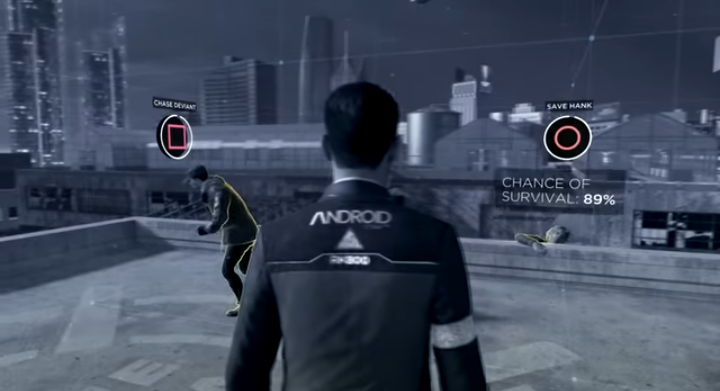
The moment of choice.
This moment reflects the philosophical thought experiment known as the Trolley Problem, a moral dilemma frequently taught in classrooms which asks whether it is ethically justifiable to sacrifice one life to save many. Here, however, the dilemma is no longer abstract. The player must choose between saving someone they have grown emotionally attached to, or stopping a deviant who has the potential to go on and harm countless others. Chasing the deviant prioritises Connor’s duty to society and aligns with his programmed efficiency as a machine designed to prevent future damage caused by rogue androids. However, this choice comes with a cost: an 89% likelihood of destroying Connor’s relationship with Hank, a character the player has spent much of the game beside. Saving Hank highlights our loyalty, emotional connection, and the value in a human life.
What makes this moment important is not its similarities to philosophy textbooks, but the context and pressure under which the reality of the predicament is experienced. There is no pause for reflection or a classroom debate beforehand. The choice must be made instinctively, and whatever the player chooses becomes part of Connor’s identity going forward. Ethics here aren't abstract principles, but rather are lived experiences.
Detroit: Become Human highlights how games can teach ethical reasoning not through explanation, but through consequences. Players are not told what morality is, but are asked to practice it, imperfectly, and to live with the outcomes.
Reflection and Learning in The Last of Us
The Last of Us offers another prominent example of how video games can teach ethics, though it does so through complicity and reflection rather than direct choice. Unlike games built around branching paths and scoreboards, The Last of Us places players within a fixed story-line still filled with morally complex situations that create the illusion of choice, even if the outcome of the game cannot itself be changed. Set decades after a deadly cordyceps infection has spread across the United States, this zombie apocalypse-esque game is filled with tough decisions, emotional losses and terrifying realities where doing the ‘right’ thing is rarely clear
You begin playing as Joel Miller, a survivor shaped by emotional losses, who is tasked with protecting the young Ellie Williams by smuggling her to a militia group known as the Fireflies. Ellie is an orphaned teenager, who we later find out is immune to the cordyceps infection, and who has the potential to be used to create a vaccine to ensure the survival of the human race
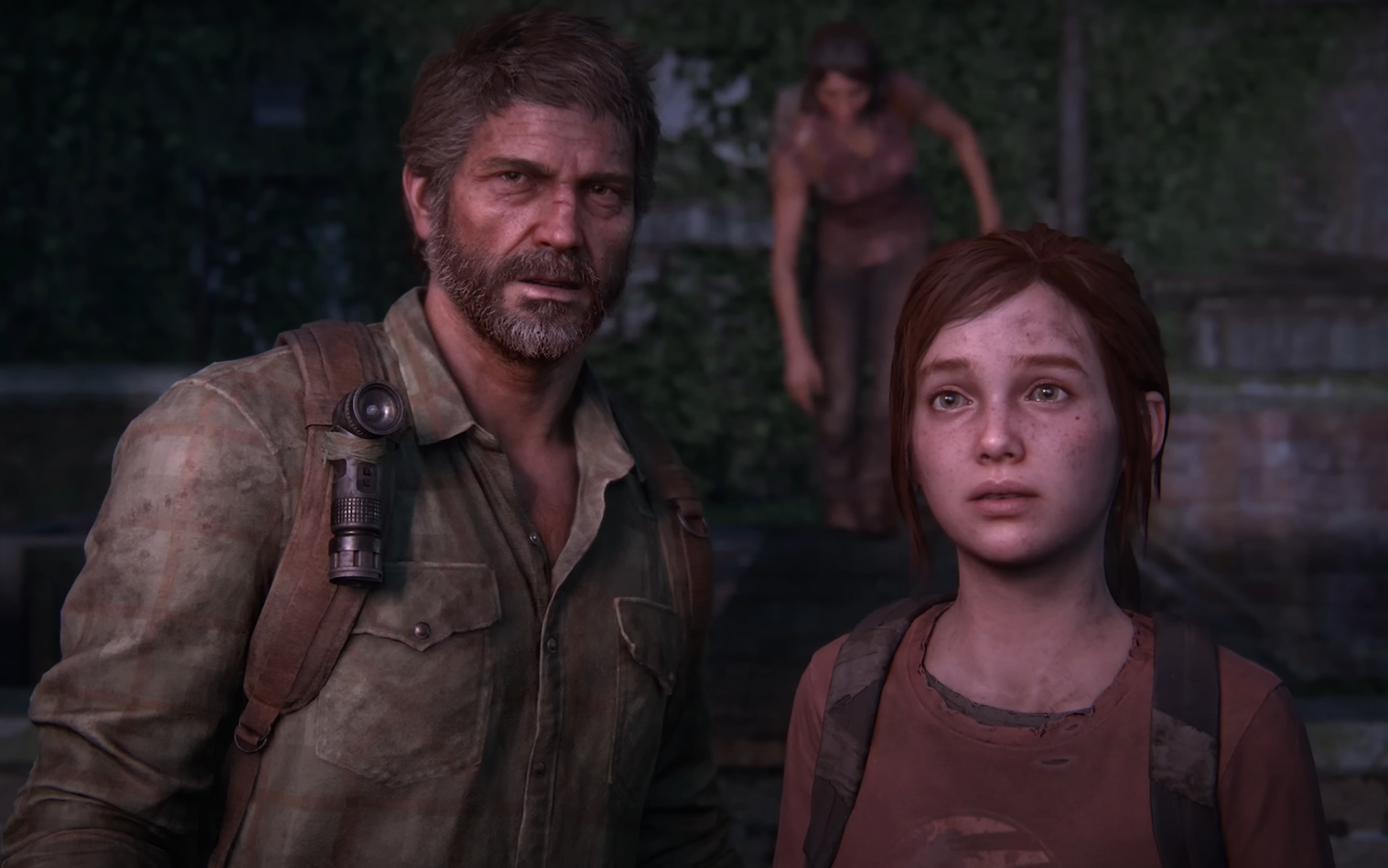
Joel Miller (Left) and Ellie Williams (Right) in game.
As the game progresses, Joel and Ellie begin to form a close bond; Joel caring for her like he would his own daughter. They travel across the country, forming new alliances, encountering enemies, and losing friends along the way. Near the end of the game, Ellie nearly drowns crossing a flooded terrain but Joel saves her in time, only to lose consciousness himself. When he wakes, he finds himself in the Fireflies hospital, where he learns that Ellie is being prepared for surgery, learning that her immunity is due to a mutated Cordyceps fungus in her brain, and that in order to create a cure, the doctors must remove the infected part of her brain, a procedure which would kill her in the process. In addition, we learn that Ellie is unaware of what is about to happen and has never given her consent. This is where Joel is forced to act, rushing into the surgery room and to save Ellie, making the decision to save her by taking her away despite knowing that killing her and harvesting the immunity from her brain would likely result in a vaccine to save many more lives.
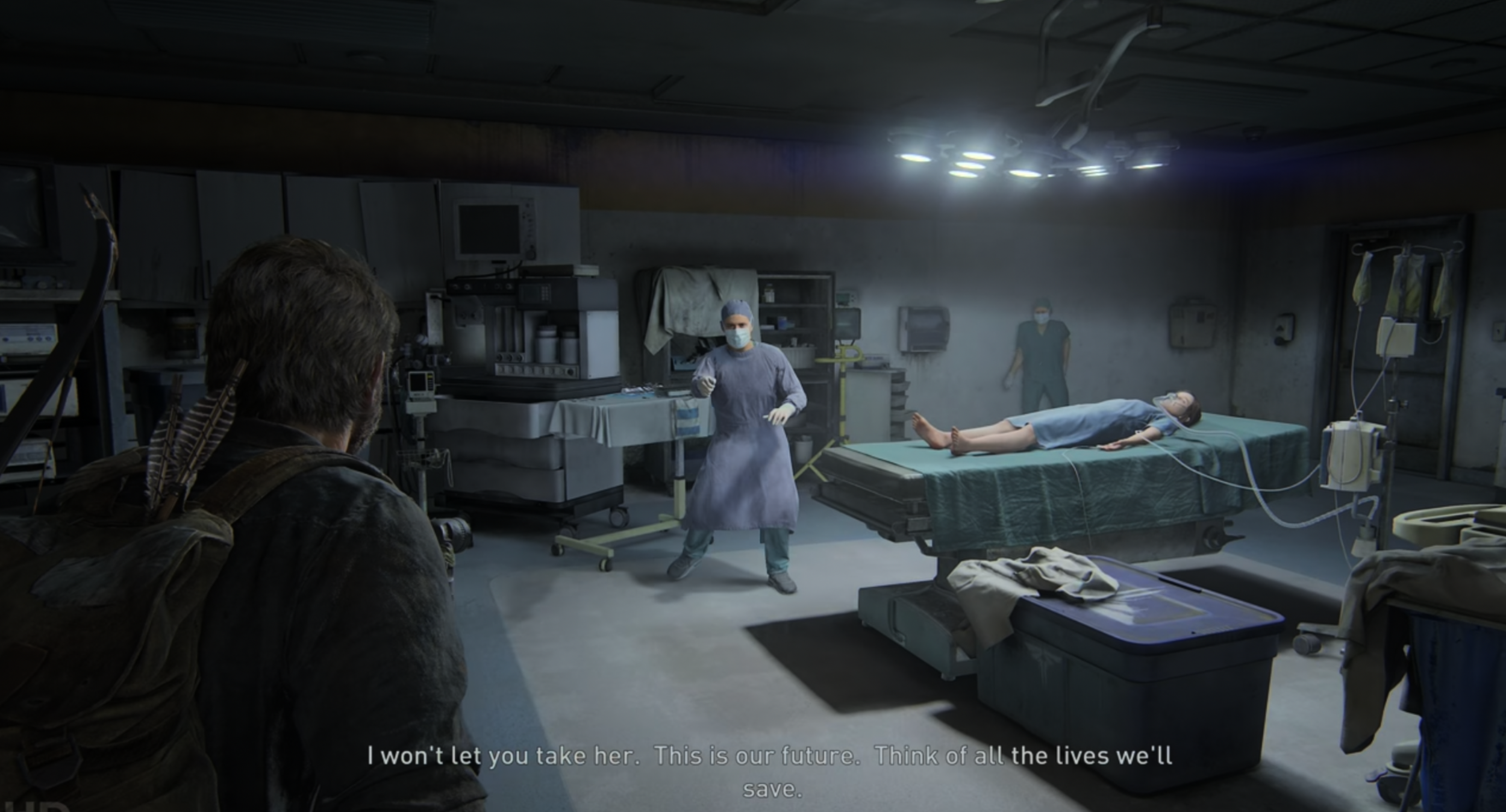
Joel rushes into the surgery room to save Ellie, who lies on the operating table unconscious
What makes this moment so emotionally charged is that it is the collapse of everything the game has been building towards. The thousands of miles players have travelled, the people lost along the way, their sacrifices made to reach this point are all now rendered meaningless by a choice that refuses to be abstract.
This scene works as a teaching tool as it's a classical case of clashing utilitarianism versus care ethics. One of the medical staff tells Joel, ‘This is our future. Think of all the lives we will save’, a utilitarian response, in which we sacrifice one to save many. Yet, Joel responds with care ethics, choosing to protect the one he loves. Ethics here are not taught through explanation or debate, but through emotional reckoning, leaving players to confront what they are capable of justifying when someone they love is at stake.
The Last of Us can also be seen as a successful education tool as it sparks curiosity in biology through its impeccable graphics and narrative immersion. While the cordyceps fungus in the game is fictionalized, it is inspired by a real life parasitic fungus which infects insects and manipulates their behaviour, Ophiocordyceps unilateralis, also known as the ‘zombie-ant’ fungus. The fungus takes the host of the insect and causes erratic behaviours in them and upon the insect’s demise, a fungal growth bursts from the host’s head, releasing spores that will claim their next target.

The Last of Us infected human.

Example of infected zombie-ant.
The fascination with this idea has generated much real-world interest beyond gaming culture. The Infectious Disease Prevention assistant professor at the Yale School of Medicine, Scott Robert, started to publicly discuss the Scientific plausibility of such a fungal mutation in humans having been prompted by the game’s popularity as well as a research paper from the Environmental Molecular Sciences Laboratory by biotechnology scientist Scott Baker stating that The Last of Us has led to an increased interest in fungal research as a whole worldwide.
Rather than teaching biology through diagrams and hypotheses, The Last of Us teaches players about pathogen spread, zoonotic diseases, mutation and the loss of control when outbreaks spiral and cause system collapse, all through video game simulations. This kind of engagement conveys broader possibilities for education, where topics can be introduced not through reading and memorisation alone but through simulation.
There are many other games which approach this kind of learning more directly. Strategy games such as Plague Inc, allow players to control a deadly pathogen that can infect and wipe out humanity, allowing players to experiment with transmission, mutation and containment and learn how diseases spread. These games teach us that biology is not something to simply memorise, but something we should interact with, suggesting that when scientific concepts are fictionalised and embedded within gameplay, curiosity becomes a powerful engine for learning.
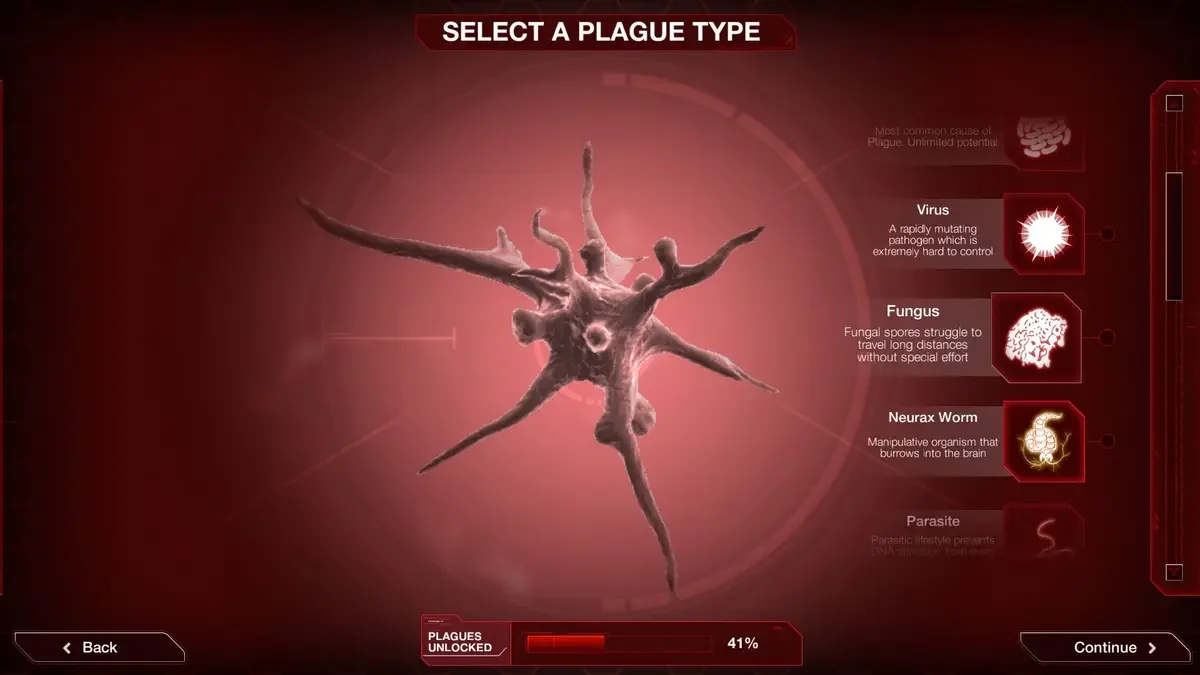
Example from Plague Inc.
Systems in SimCity
Not all games teach through character or story. Some teach by placing players inside systems, webs of direct cause and effect where no single decision exists in isolation. In these games, the role of the player is not that of a character, a survivor or a hero, but rather, players become planners, policymakers and leaders.
This is most clearly seen in the city-building game SimCity. In this game, the player acts as mayor and is given a blank map to begin building and maintaining a functioning city from scratch. Proper management of the city requires players to provide citizens with basic utilities such as electricity and water, and even public services like health, education safety, parks for leisure and more. While the choices initially seem straightforward, we quickly learn that there are consequences for every choice. While lowering taxes earns public favour and encourages growth, it reduces funding for public services. Expanding industries can create jobs and grow the city, but it also increases pollution, which may raise healthcare costs and lower quality of life later on.
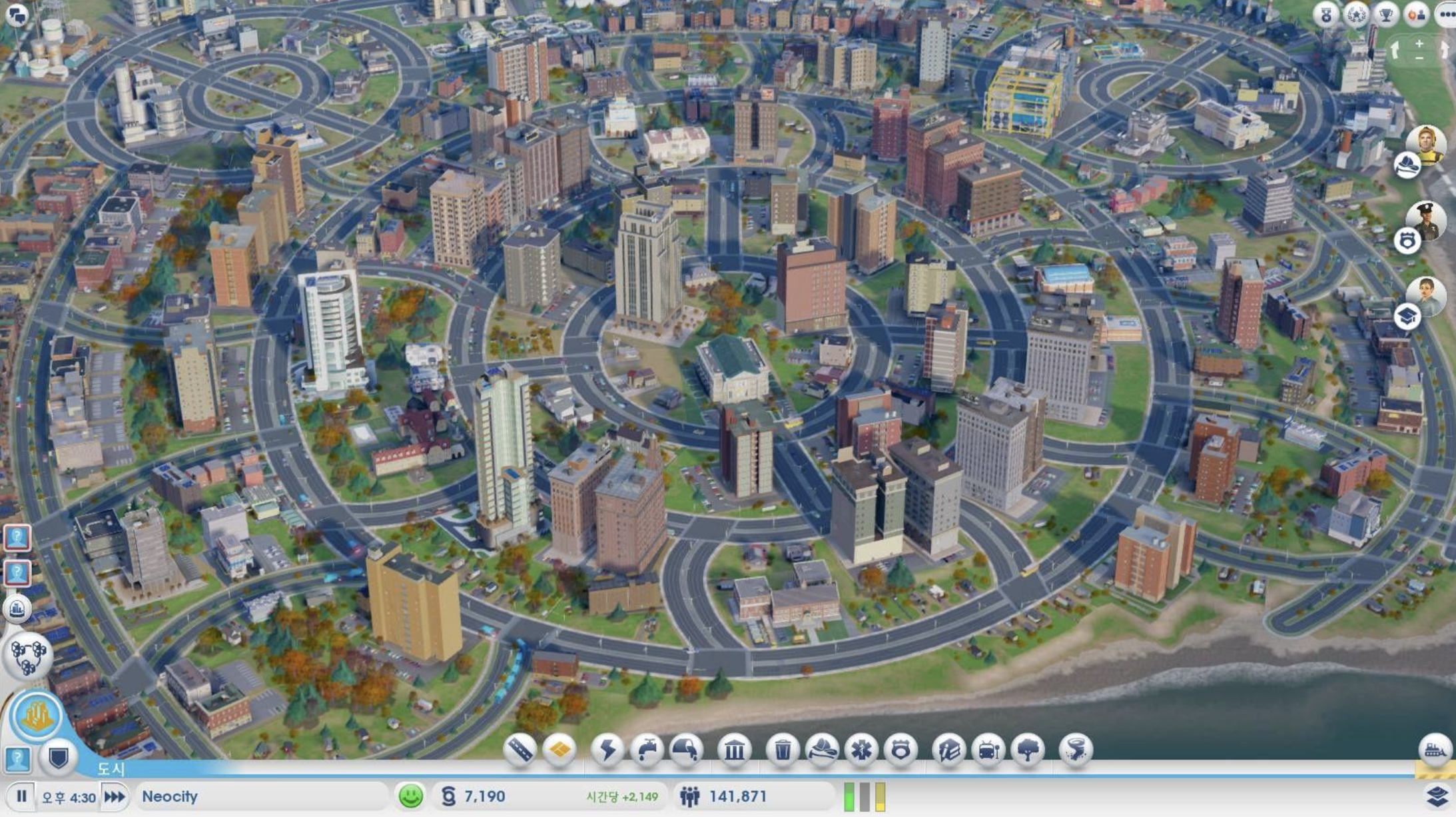
Example from SimCity game.
By mirroring real world systems, the game shows the benefits and limitations of leadership. It offers no simple correct solution, but rather allows players to experiment and see the consequences of their decisions. This teaches them that roles of big responsibility, such as this one, are actually very complex and how choices carry long term effects.
This was echoed by Robby DeMartino, Co-President of PENNUPGRADE, the University of Pennsylvania’s game development club. When I interviewed DeMartino, he told me how a few years ago he went on a deep dive for open source games, ‘‘I’m a huge open source advocate. So I was looking for an open source city planning game. I wanted to play SimCity”, and highlighted its benefits and accuracy in replicating how cities actually grow. He also recommended a link to a game called Citybound, which markets itself as a building game that uses microscopic models to vividly simulate the organism of a city arising from the interactions of millions of individuals. “It’s an entertainment simulation game. This seems like something which is much more focused on an actual kind of simulation of the way that cities grow”.
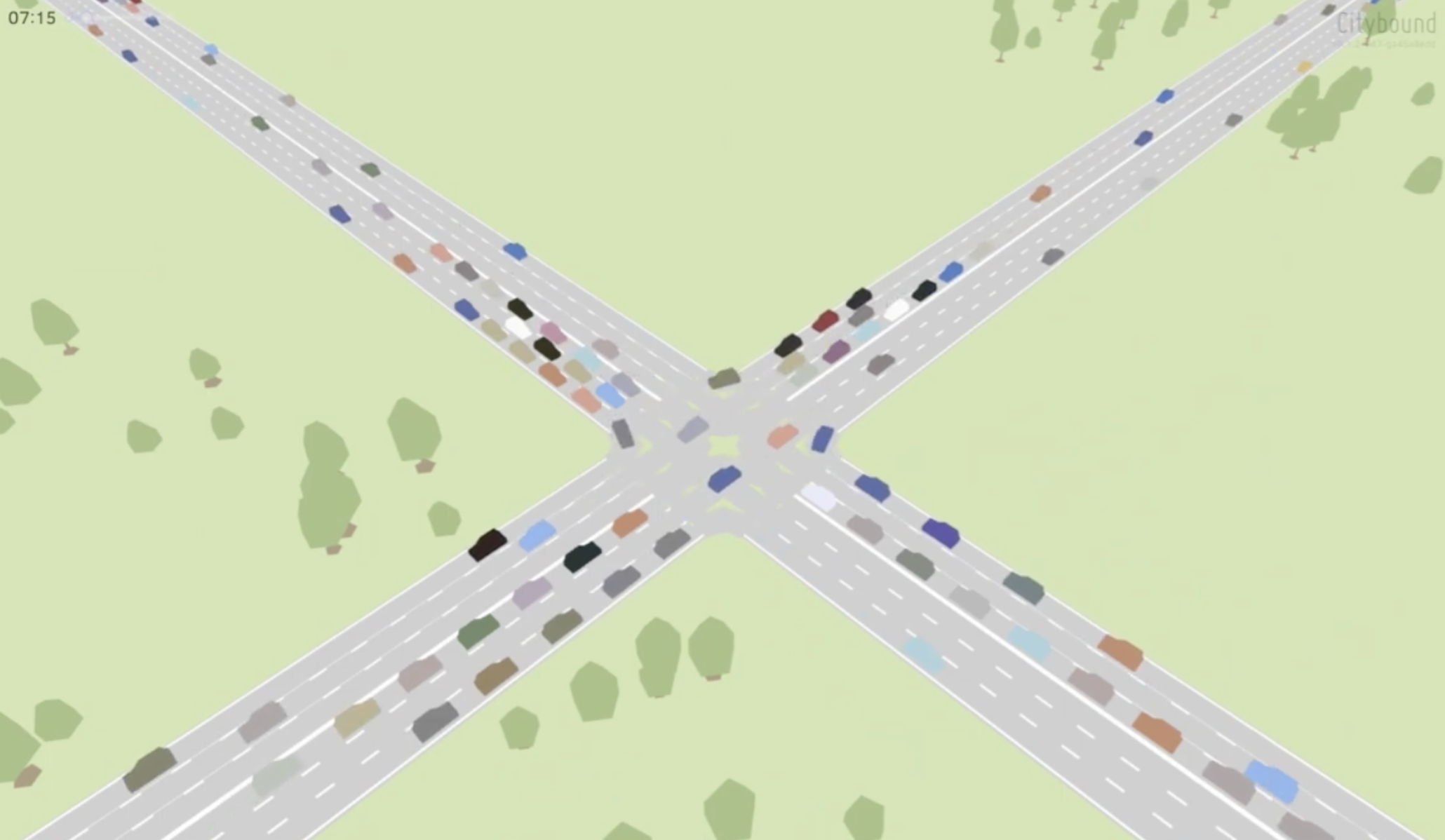
Example and test run of an efficient flow of traffic from Citybound.
Teachers have already begun experimenting with this type of systems based learning. Matthew Farber, an associate professor of educational technology and co-director of the Gaming SEL Lab at the University of Northern Colorado, wrote on an experiment he did where his sixth grade social studies students began playing SimCityEDU beta, released as a series of games. One of these games was the Pollution Challenge! in which players, acting as mayor, are challenged with addressing environmental impact while maintaining employment levels and citizens happiness. Farber highlights how his students “learned the mechanics quickly” and that “games enable my students to discover different ways of solving problems, which is more like life and less like standardized tests… My next step is to "gamify" existing activities and team-based projects”. As students learn the trajectories and outcomes of dealing with real life policy decisions, abstract and complex concepts like environmental responsibility and its relevant systems become more tangible.
Where narrative driven games encourage reflection on choices, city simulations like SimCity reveal how responsibility scales. They reveal that in complex systems, good intentions are rarely enough. Understanding comes not from being told how systems work, but from living inside them.
To Learn or To Latch?
We can see clearly that these games are capable of teaching ethics, biology, systems and responsibility through experience, but we must ask a further question: is this learning intentional? Or are players diving too deeply into something primarily designed by its creators to be addictive for maximum profit and pure entertainment?
I posed this question to Levi Gans, a near graduate preparing to join a video game startup, where I asked whether he believes games can teach players something meaningful. He was quick not to romanticise the subject, “I definitely think so but I think some can be very harmful in teaching things as well, though. But, a lot of it is thinking to find the solution to problems in front of you and sometimes working with teams which are always good lessons to work on”.
What stood out most in Gan’s interview was his emphasis on ethics. Going to work for a gaming company whose gaming products intersect with gambling - he could see that there is an ethical responsibility which will bleed through into design decisions. He explained that “we always want to make sure that everything we do is ethical. We also want to find ways to connect with the users, but most of all to act in ways that keep our image in a good light and not as bad actors”.
Gans was also honest with the company's motives. When asked whether he thought about the messages their games send or if it was secondary to things like profit, he explained that, “For us, the message and branding is everything”. While gameplay experience must be without flaw and companies remain profitable, he argued that long-term engagement and fan loyalty will depend only on if people connect with their brand and a game's values.
It was also beneficial to get the perspective of a video game student, Alex Xenophontos who studies game art and design at a University in Nottingham, and has been an avid player of games his entire life. He explained that games like Detroit: Become Human are “good at making you question your morality with decision making and it's a gamble whether or not your choices would dramatically change your run, much like real life”.
He also pointed out that games like The Last of Us, particularly the second game in the series, force players to “question whether or not you should be killing all these people on your path to victory. It's fun to play but because of the presentation and voice acting you start to regret killing other people”, and he highlights how while the narrative and gameplay remain engaging, the emotional weight of the storyline starts to become uncomfortable, especially as the series progresses.
This discomfort is not accidental, Robby DeMartino also specifically described how The Last of Us Part II deliberately uses violence as a teaching tool through its increasing discomfort. He explains “the mechanics are very violent, but the game is definitely anti-violent because as you go through the story the violence gets more intense and violent and gruesome and you start to become disillusioned with it over time as you see more nuances of the people you are fighting against instead of a flat other evil but actually people in their own right”.
He explains that this results in a kind of “separation from what your character wants to do and what the player wants to do”. While the characters continue to be driven towards slaughter, the player increasingly resists it. When this violence becomes exhausting, a paradox is created which may teach players what they themselves would be willing to justify if faced with the same pressures in real life.
When I asked DeMartino whether there were any games which he felt had actually had an impact on his life, he told me, “there have been multiple actually. But probably the easiest to point to, and this is one where if you were to ask a hundred gamers a decent percentage of them will mention Undertale, but it is written in a way that makes you feel like the characters are real in some way. It breaks the fourth wall in the way that it makes the game's core mechanics, like the saving and loading, a part of the world. It breaks that barrier down and brings you into it, and the writing is such that it can make you feel like all the characters you meet along the way are actually living out there somewhere. Obviously they are not, but it makes you feel that way, and I think that that can be really impactful”.
When I followed up by asking if he thought the next generation of developers will be more intentional about using games as tools to teach, specifically with subjects like ethics, biology or systems, he responded saying, “I think that the next generation is doing that now and it will continue to do that, as what you are really describing is kind of the evolution of games as an art form and making it have deeper meaning than just entertainment. Obviously there will still be games just for entertainment, just like there are books and movies just for entertainment, but there are also a lot of really high quality movies and what not that explore all of these deep topics, and I feel that as thevideo game industry evolves and has been evolving for the last twenty years, we have seen a lot more of that happen and we will continue to see more of that happen”.
